






Jizzakh province
Established: 1973.
Area: 21,2 thousand sq. km.
Population: 996,9 thousand.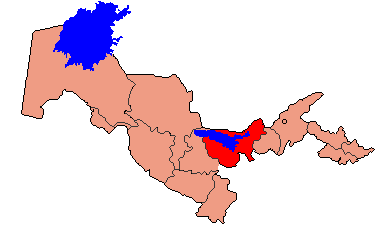
Jizzakh province is located in central part of the country, There are 12 rural districts in the province -Arnasoy, Bakhnial, Ghallaorol, Jizzakh, Dttstlik, Zomin, Zarbdor, Zafarobod, Mirzachul, Pakbtakor, Forisb, Yangiobod; 1 towns - Gagarin, Ghallaorol, Dashtobod, Jizzakh, Dustlik, Marjonbubk, Pakbtakor; 8 town-type-settlements - Buston, Zomin, Zarbdor, Zafarobod, Kuytosb, Usmat, Ucbkulok, Yangikisblok; and lOl villages.
City of Jizzakh is the administrative center of the province (203 km from Tashkent)
Agriculture: cotton, grain crops, and livestock farming.
Industry: Electricity, ferrous and non-ferrous metallurgy, chemical and food industry, machinery, construction materials, wood reprocessing, and flour grinding,
The sands of the Kyzyl Kum Desert cover the central, northern and northwestern parts of the province. The province is semi-circled by the Turkestan and Nurata Mountain Ranges from the west. A narrow valley of the Sanzar River, also known as the "Gates of Amir Temur", divides them.
The climate is continental with hot and dry summers and relatively mild winters, The lowest temperature in winter reaches 27 degrees Celsius below zero and 45 degrees Celsius above zero in summer. The dry climate and frequent winds in summer prompt high levels of evaporation. Closeness to mountains in certain places makes it possible to grow grain.
The major rivers are Zaminsuv and Sanzar; the Eski Tuyatartar canal, as well as many small streams such as Acbisoy, Jaloir, Ravot coming from cliffs of the Turkestan and Nurata Mountain Ranges.
The plants and animals in the Zomin Forest Mountain Park, located on the northern slopes of Turkestan Mountain Ranges, are accustomed to the harsh desert climate.
The rich natural resources of the province assured the establishment and development of certain industrial enterprises. Enterprises that produce construction materials are provided with local raw materials such as gypsum, limestone, marble, and others. There are rich deposits of non-ferrous metals in the mountains that encircle the Jizzakh province. The leading branch of industry is an electricity production. The heavy metallurgy, machinery production, timber, wood processing, light and food industries are well developed. There are 94 state industrial enterprises in the
province. The plants producing construction materials and plastics, knitting fabric, cotton processing plants, cotton harvesting bases and housing construction enterprises are just a few examples of local industrial activity.
There are 16 joint ventures, 457 SME and 33 cooperative enterprises. The Uzbek-Syrian "Pakhta International", Uzbek-British "Jibchi", Uzbek-Tajik "Kumusb tola", Uzbek-Pakistani "Irjartextile", Uzbek-Chinese "Maciina", "Bereke-Lupsen", Uzbek-Italian "Pakblakor-Anjent", "Anjent International", "Bobur", Uzbek-Ukrainian "Baselt", Uzbek-Portuguese "Lockistir" are strategically important joint ventures in the province.
The leading branch of agriculture is cotton cultivation. In addition, the livestock farming, grain, vegetables, grapes, cocoon production and beekeeping are well developed.
The main form of transportation is automobiles. The length of automobile roads is 4,1 thousand km. The main highways arejizzakh-Guliston (100 km), Jizzakh-Samarkand (90 km), Jizzakh-Pakhtakor (27 km),Jizzakh-Ettisoy (65 km),Jizzakh-Tashkent (180km), Marjonbulok-Tashkent (220 km). The length of the railroad network is 217,8 km.
There are 488 general secondary schools in the province. Besides, there are lyceums, gymnasiums, the pedagogical institute, and the branch of the Tashkent Technical Institute, the Military Aviation College, as well as specialized sporting and musical schools.
Two theaters, 173 clubs, 302 libraries, 4 museums, 72 healthcare establishments, and 3 sanatoriums operate in the province.

 Kazakhstan
 Kyrgyzstan
 Tajikistan
 Turkmenistan
 Uzbekistan